.svg)

AI for Payroll: How It Works and How to Use It


Artificial intelligence is no longer a future-state conversation for businesses. It's already here, and it's working.
Across every industry, AI is quietly showing up in daily routines. A manager uses it to draft a report in half the time. A scheduler asks it to help balance shift coverage across three locations. An office administrator uses it to sort through invoices. A regional director drops in last quarter's numbers and gets a summary with trends they would have spent hours pulling together manually.
And it's not just organizations rolling out AI from the top down. Employees at every level are finding their own ways to use AI to write clearer emails, organize messy data, or simply get through administrative work faster. The shift is happening from both directions at once.
But here's where it gets interesting: most of this adoption is still surface-level. Faster writing. Smarter search. Quick answers. That's the tip of the iceberg. The real transformation starts when AI moves beyond assisting with everyday tasks and starts working inside core business operations, the complex, high-volume, high-stakes processes where accuracy matters and small errors compound fast.
Finance is one of those areas. And within finance, payroll is one of the biggest untapped opportunities. That's what this guide is about: how AI applies to payroll specifically, what it can actually do, and how to adopt it the right way.
Why Payroll Needs AI
Payroll is deceptively complex. From the outside, it looks like a process that should just work, calculate hours, apply rates, cut checks. But anyone who actually manages payroll operations knows the truth: it's one of the most rules-heavy, exception-dense, high-stakes functions in any organization.
Consider what payroll teams are actually managing:
- Constantly shifting regulations. Federal, state, and local tax laws change frequently. Labor regulations vary across jurisdictions. Collective bargaining agreements layer in additional rules that differ by union, location, and role. Staying current is a job in itself.
- Multi-system complexity. Payroll data doesn't live in one place. It flows from time and attendance systems, HR platforms, benefits administrators, scheduling tools, and ERP systems. Every handoff is a potential point of failure.
- High volume, zero margin for error. A mid-size organization processes thousands of pay records per cycle. Each one needs to be accurate, the right rate, the right hours, the right deductions, the right tax treatment. Every time. The cost of getting it wrong goes far beyond dollars. Payroll errors create compliance exposure, audit risk, and legal liability that can compound quickly.
- Manual review bottlenecks. Most payroll teams rely on spot checks, manual reconciliation, and institutional knowledge to catch problems. That works until it doesn't when a key person leaves, when volume spikes, when a new regulation takes effect, or when the team simply runs out of time.
And that's the real issue: time. Payroll teams are consistently under-resourced relative to the complexity they manage. The work of reviewing, consolidating, and validating payroll data requires analyzing massive volumes of information while applying the same high level of accuracy and precision every single cycle. When time runs short, and it always does, the corners that get cut leave the organization exposed.
Traditional payroll systems are built for processing, not for analysis. They execute rules, but they don't question whether those rules were applied correctly. They don't flag patterns across pay periods. They don't catch the errors that only become visible when you see the context. That's the gap AI can close.
How AI Can Be Used in Payroll
When most people hear "AI in payroll," they picture a robot replacing the payroll manager and processing their payments. That's not what this is. AI in payroll is an accuracy and intelligence layer that sits on top of existing payroll systems, analyzing data at a scale and speed that humans simply can't match. Because unlike humans, AI can process massive amounts of data simultaneously while maintaining the same level of accuracy and consistency every time.
Here's what that looks like in practice:
Error Detection and Anomaly Flagging
AI can analyze payroll data across every employee, every pay code, and every cycle and flag anomalies before checks go out. That means catching duplicate payments, rate mismatches, unexpected overtime spikes, or deduction inconsistencies before they become problems. Instead of relying on spot checks, you get a full-coverage review every run.
Compliance Monitoring
Regulations change constantly. AI can continuously monitor payroll outputs against federal, state, and local requirements as well as collective bargaining agreements and internal policies and flag potential violations in real time. This is especially critical for organizations operating across multiple jurisdictions, where keeping track of every rule change is nearly impossible.
Continuous Audit and Reconciliation
Traditional payroll audits happen periodically, quarterly, annually, or when something goes wrong. AI enables a continuous audit approach, reconciling payroll data against source systems (time and attendance, HR, benefits) on an ongoing basis. Surfacing discrepancies immediately.
Overtime, Rate, and Classification Validation
Misapplied pay rates, incorrect overtime calculations, and employee misclassification are among the most common and costly payroll errors. AI can validate that the right rate was applied to the right employee for the right hours worked across every record, and flag exceptions for human review.
Benefits and Deductions Accuracy
Benefit elections, deduction changes, and enrollment events create a steady stream of data that needs to flow correctly into payroll. AI can verify that deductions match elections, that changes are reflected on time, and that no one is over- or under-dedicated.
Labor Cost Forecasting and Predictive Analytics
Beyond accuracy, AI can help finance leaders see forward. By analyzing historical payroll data alongside workforce trends, AI can model labor cost projections and identify seasonal patterns. It can also provide early signals on cost drivers, giving leadership better data for budgeting and strategic decisions.
The Benefits: What AI Actually Changes for Your Payroll Operation
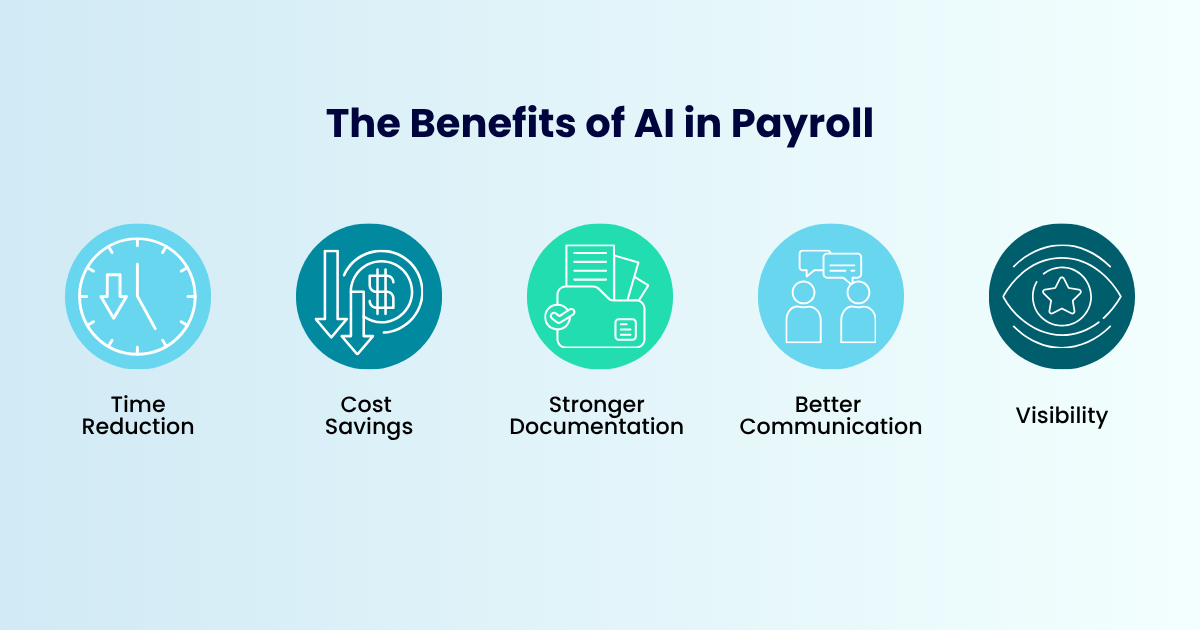
Time Reduction
Payroll teams spend a disproportionate amount of their time on manual review, reconciliation, and chasing down discrepancies. AI handles the heavy lift, scanning every record, every cycle, so your team can then only review flagged exceptions. A process that used to take days of line-by-line review can be reduced to hours of focused, exception-based work.
Cost Savings
Payroll errors cost money in two directions: overpayments that go unnoticed and penalties that come after the fact. AI catches both. When you're flagging rate mismatches, duplicate payments, and deduction errors before checks go out, you're not just improving accuracy, you're directly recovering dollars that would have otherwise walked out the door. And on the compliance side, catching violations early means avoiding the fines, back-pay liabilities, and legal costs that come with getting it wrong.
Stronger Documentation and Audit Readiness
One of the quieter benefits of AI in payroll is the audit trail it creates. Every flag, every review, every resolution is logged. That means when an auditor shows up, internal or external, you're not scrambling to reconstruct what happened. Anyone who's lived through the "Thursday scramble," that weekly crunch where payroll managers race to pull together documentation and verify everything checks out, knows how painful that process can be. AI replaces that chaos with a continuous, organized record of what was checked, what was found, and how it was resolved. That changes the entire audit experience.
Better Communication Across Teams
Payroll doesn't operate in a vacuum. It depends on clean data from HR, scheduling, local management, and finance. When AI surfaces a discrepancy, say, a rate that doesn't match what HR has on file, or a schedule that conflicts with what time and attendance recorded, it creates a clear, specific reason for those teams to connect and resolve the issue. Instead of vague escalations, you get real-time, data-driven communication between departments.
Full Visibility and Smarter Decisions
Most payroll operations run on trust and spot checks. Leadership gets a summary after the fact and assumes everything went fine. AI flips that. It gives finance, HR, and payroll a real-time view of payroll health: where the errors are, how often they recur, which locations or departments have the most issues, and how accuracy is trending over time. That visibility matters more than most people realize. Underpayments get flagged fast because employees notice. But overpayments? Those tend to disappear silently into the budget, unnoticed and unrecovered. AI catches both, which means you're not just protecting employees, you're protecting margins. That's not just operational visibility, it's the foundation for better workforce planning, budgeting, and strategic decisions.
Risks and Red Flags to Watch For
AI in payroll carries real potential but it also carries real risk if you use it carelessly. Here's what to watch for:
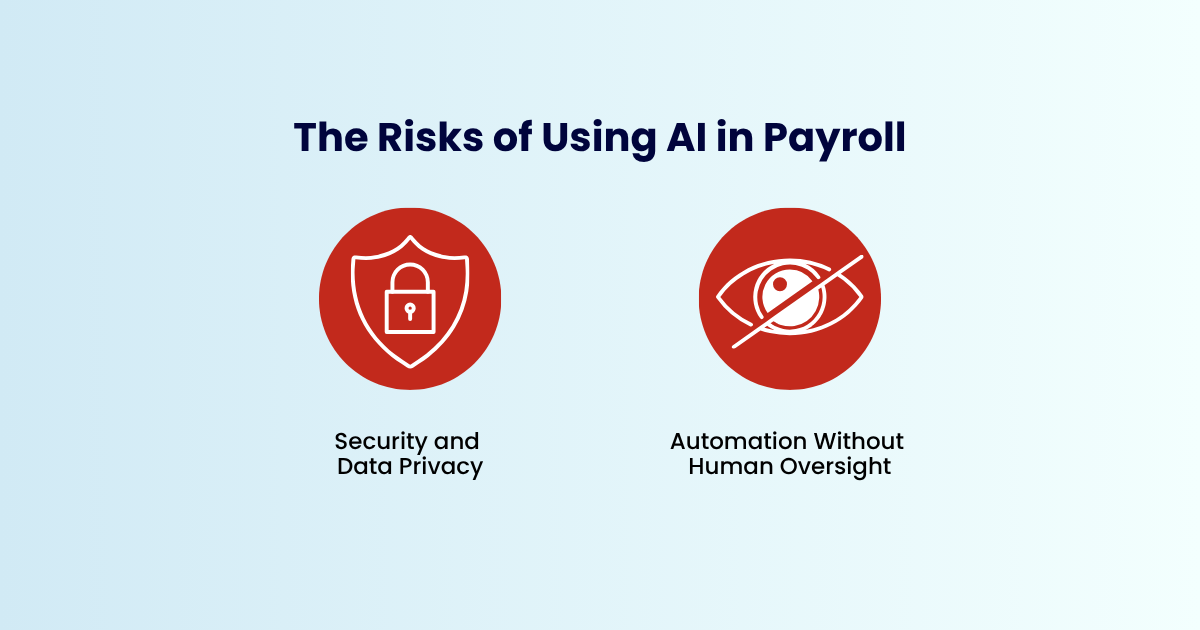
Security and Data Privacy
This is the big one. Payroll data is among the most sensitive information any organization handles: Social Security numbers, bank account details, wage information, tax records. This data should never touch unsecured platforms.
That means free AI tools, general-purpose chatbots, and consumer-grade platforms like ChatGPT, Google Gemini, or similar tools are not appropriate for payroll work no matter how convenient they seem. These platforms may store, process, or train on your data in ways that violate privacy regulations and put your employees' personal information at risk.
Any AI tool you use for payroll must be purpose-built, SOC 2 compliant, for handling sensitive financial and personal data, with enterprise-grade security, encryption, access controls, and clear data governance policies.
Over-Automation Without Human Oversight
AI should augment your payroll team, not bypass it. The goal is to surface issues for human review and decision-making not to auto-correct payroll without someone verifying the output. Keep humans in the loop, always.
Questions to Ask Any AI Payroll Vendor
Before you sign anything, ask:
- Where is our data stored, and who has access to it?
- Is the platform SOC 2 compliant? What security certifications do you hold?
- Can we see the reasoning behind every flag or recommendation?
- How does the tool integrate with our existing systems?
- Does your AI learn from our data specifically, or from a shared data pool?
- What does implementation look like, and what resources will we need internally?
.png)
AI Built for Payroll: Celery
Celery is an AI-powered payroll review platform trusted by organizations managing complex, high-volume payroll operations. Not a general-purpose AI tool adapted for payroll, but a system designed from the ground up to do one thing: make payroll more accurate, more compliant, and more efficient.
.png)
How Celery Works
Celery sits on top of your existing systems (Payroll, HRIS, T&A, and others). It doesn't replace anything, it connects to the tools you already use and continuously analyzes your payroll data simultaneously.
The platform ingests your data, applies checks trained specifically on payroll patterns, and flags errors, anomalies, and compliance risks before payroll is finalized. Your team then reviews the findings, takes action, and moves forward with confidence.
AI That Learns Your Context
Celery's AI doesn't just apply generic rules. It learns the specific context of your organization, your pay structures, your collective bargaining agreements, your policies, your patterns. Over time, it gets smarter about what's normal and what's not in your payroll environment, reducing noise and surfacing the issues that actually require attention.
Custom Policies and Rules
Every organization has unique payroll rules. Celery allows you to define and enforce custom rules alongside its AI-driven analysis so you're not just catching what the machine finds, you're also ensuring your own internal standards are met.
ROI
Organizations using Celery have identified significant payroll discrepancies that would have gone completely undetected through traditional review processes. Across over $1B in audited payroll data, Celery consistently surfaces errors, discrepancies, and risky patterns. The impact is measurable: clients have recovered up to 2% of total payroll costs in errors caught before they became losses, while reducing the time spent on payroll review by up to 91%.
Making Payroll Smarter Starts with Knowing What's Possible
AI in payroll isn't a future initiative, it's already here, and the organizations adopting it are seeing real, measurable results: fewer errors, faster reviews, stronger compliance, and clearer visibility into one of the most complex functions they manage.
The takeaway is simple: you don't need to overhaul your systems or replace your team. You can still enjoy a smarter layer on top of what you already have. AI that catches what manual processes can't, keeps up with the complexity your team is managing, and gives leadership the confidence that payroll is accurate before checks go out.
Whether you're just starting to explore AI for payroll or you're ready to evaluate specific solutions, the right first step is the same: understand your current gaps, ask the right questions, and talk to people who've built for this problem specifically.
We're always happy to have that conversation about what AI can and can't do for your payroll operation.